Strategy >
Business ownership and enterprise
COVERS ALL MAJOR EXAM BOARDS
Teaching Business
Entrepreneurs
A clear guide to entrepreneurs, covering why people start businesses, the characteristics they need and how their role changes as the business grows.
10

Created by an experienced Head of Business and examiner
_edited.png)
AQA | Edexcel | Cambridge | Eduqas | WJEC | OCR | GCSE
KEY POINTS
Entrepreneurs start and develop businesses by spotting opportunities, taking risks and organising resources.
People set up businesses for financial motives, such as profit, and non-financial motives, such as independence, passion or social impact.
Common entrepreneurial characteristics include risk-taking, resilience, focus, passion, innovation and adaptability.
Entrepreneurs face challenges such as finance, cash flow pressure, competition, uncertainty and limited experience.
As a business grows, the entrepreneur’s role often changes from doing everything personally to leading people, delegating and making strategic decisions.
KEY DEFINITION
Entrepreneur
An entrepreneur is a person who identifies a business opportunity, takes risk and organises resources to start and develop a business.
Main Explanation
An entrepreneur is someone who starts and develops a business by identifying an opportunity and taking the risk of turning that opportunity into a product or service. Entrepreneurs are important because they create new businesses, jobs, innovation and competition. They often bring together ideas, finance, labour and other resources to create value for customers.
People set up businesses for different reasons. Financial motives include the desire to earn profit, build personal wealth or gain a higher income than they could receive as an employee. However, many entrepreneurs also have non-financial motives. These may include independence, personal ambition, passion for a product, flexible working, social impact or the desire to solve a problem they care about.
Successful entrepreneurs often need a mixture of personal characteristics. They may need to be risk takers because there is no guarantee that the business will succeed. They need resilience because start-ups often face rejection, mistakes, delays and financial pressure. They also need focus and passion because building a business can require long hours and sustained effort before success is achieved.
Innovation and adaptability are also important. Entrepreneurs may create a new product, find a new way to serve customers, use technology differently or target a market that existing businesses have ignored. However, markets can change quickly. Entrepreneurs may need to adjust their product, pricing, marketing, suppliers or operations as they learn more about customers and competitors.
Setting up a business can be challenging. Entrepreneurs may struggle to raise finance because lenders and investors see start-ups as risky. Cash flow may be weak because costs often need to be paid before sales revenue is received. Entrepreneurs may also lack experience in areas such as marketing, recruitment, finance, operations or legal responsibilities.
Entrepreneurs also face uncertainty. Demand may be lower than expected, competitors may respond quickly, suppliers may be unreliable and costs may rise. This means entrepreneurs must make decisions with incomplete information. Good entrepreneurs are not reckless; they try to manage risk by researching the market, preparing a business plan, controlling costs and listening to feedback.
As a business grows, the role of the entrepreneur often changes. In the early stage, the entrepreneur may be directly involved in almost everything: designing the product, serving customers, managing social media, handling cash flow and solving daily problems. This hands-on approach can help the entrepreneur understand the business closely, but it may become inefficient as the business expands.
Growth usually requires the entrepreneur to become more of a leader and manager. They may need to recruit employees, delegate responsibilities, build systems, develop managers and make strategic decisions. This can be difficult because the skills needed to start a business are not always the same as the skills needed to lead a larger organisation.
Overall, entrepreneurs play a vital role in business activity because they turn ideas into real organisations. However, entrepreneurship involves risk, uncertainty and pressure. The success of an entrepreneur depends on the quality of the opportunity, the resources available, the entrepreneur’s skills and the ability to adapt as the business grows.
✎ EXAMINER TIP
Do not just list characteristics such as risk-taking or resilience. Explain why the characteristic matters in the specific business context and link it to outcomes such as survival, growth, innovation, cash flow or competitiveness.
KEY FORMULAS(s)
Profit and Profitability Formulas
These key formulas help you calculate different profit measures and profitability ratios used in business.

Gross Profit
Gross profit = Revenue − Cost of sales
The profit made after deducting direct costs.
!
Remember: profit shows how much money has been made, while profitability shows how efficiently revenue is being turned into profit.
DATA TABLE
Income Statement for North Coast Coffee Ltd
This statement shows how revenue is converted into gross profit, operating profit and net profit.
Revenue
£250,000
Output
Fixed Costs
Variable Costs
Total Costs
Revenue
Profit / Loss
0 candles £1,200 £0 £1,200 £0 -£1,200
Net profit is the final profit remaining after all costs and expenses have been deducted from revenue.
Entrepreneurs: Key Characteristics
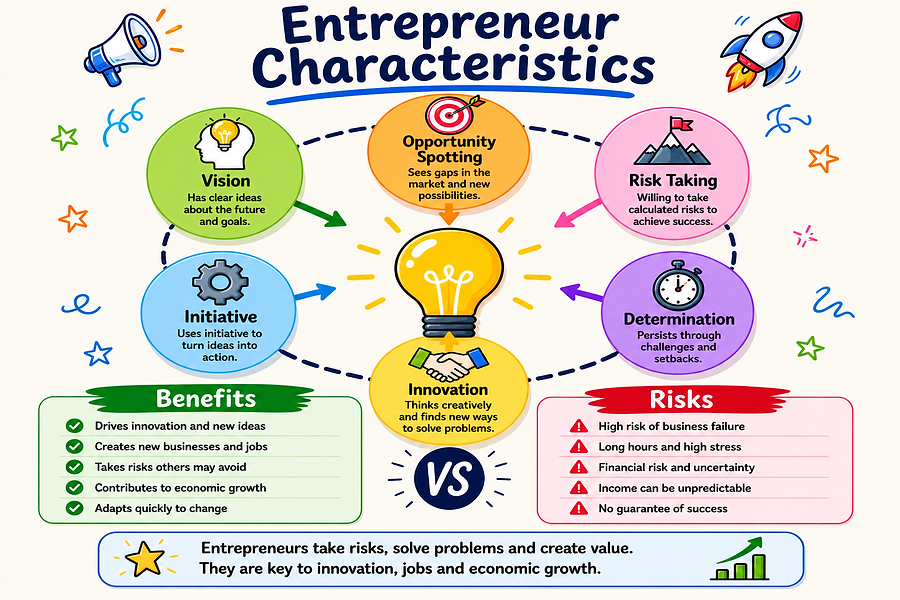
This chart shows some of the key characteristics of an entrepreneur.
WORKED EXAMPLE
Worked Example: North Coast Coffee
How many coffees must be sold to break even?

Fixed Costs
£1,800
equity + long-term debt

Break-even output = Fixed costs ÷ Contribution per unit
Contribution per unit = Selling price − Variable cost
£3.50 − £1.10 = £2.40
1

Step 1: Calculate contribution
£3.50 − £1.10 = £2.40
Contribution per unit is the amount each coffee contributes towards fixed costs.

BREAK-EVEN OUTPUT:
750 coffees per month

EXAM TIP
Always explain what the number means for the business. Do not just calculate the break-even point.

Entrepreneurs: Growing a Business

This diagram shows the main stages in growing a new business.
APPLICATION
Gymshark
Gymshark is a useful real business example for entrepreneurship because it began as a start-up and grew into a major international fitness clothing brand. Ben Francis founded the business in 2012, and Gymshark’s own story describes its early origins in a garage in Birmingham with limited resources but strong ambition.
This example shows several entrepreneurial characteristics. Francis identified a market opportunity by recognising the growth of fitness culture, online communities and social media marketing. Rather than relying only on traditional retail stores, Gymshark built a direct-to-consumer online model and used fitness influencers to reach customers in a way that felt authentic to its target market.
The example also shows risk-taking and innovation. Gymshark had to invest time and resources into product development, marketing and fulfilment without knowing whether demand would be strong enough. Its growth depended on understanding customer needs, building a community and adapting quickly to trends in fitness and fashion.
As Gymshark grew, Francis’s role changed. The business needed more formal management, specialist employees, systems, investment and strategic leadership. This illustrates the specification idea that an entrepreneur may need to move from hands-on start-up activity to leading a larger organisation.
Gymshark therefore helps students see that entrepreneurship is not just about having an idea. It involves spotting an opportunity, taking calculated risks, building a brand, learning from the market and developing leadership as the business grows.

This independent educational case study is not affiliated with, endorsed by or sponsored by Greggs plc. Any financial figures used alongside this example should be treated as simplified or hypothetical estimates created for teaching purposes.
_edited.png)
ANALYSIS
EXAM FOCUS
Analysis questions require you to examine a business concept or issue in detail, breaking it down into its component parts. You should explain how and why something happens and consider its impact on the business.

How to Approach Analysis Questions
1
Identify the key issue or concept
2
Break it down
3
Explain how and why
4
Reach a reasoned conclusion
Read the question carefully and highlight the focus of the analysis.
Consider the different factors, causes or impacts related to the issue.
Provide clear explanations using business terms and links points to context.
Evaluate the overall implications for the business.

Example Analysis Question
North Coast Coffee is considering using break-even analysis before opening a second café.
Advantages
• Sales forecasts may be inaccurate.
• Assumes costs and revenue remain constant.
• External factors may reduce reliability.
• Ignores qualitative business factors.
Disadvantages
• Sales forecasts may be inaccurate.
• Assumes costs and revenue remain constant.
• External factors may reduce reliability.
• Ignores qualitative business factors.
Key Exam Tip
If you find it difficult to expand your answer and show the type of depth that an examiner is looking for in a top response, consider using the 'so what' approach.
Tesco carry out market research - so what? - this allows them to better understand customer needs - so what? as a result Tesco can provide goods more likely to sell - so what? - this will increase Tesco profit and ensure higher levels of customer satisfaction - so what? this means that customers are likely to become more loyal to Tesco.

Avoid These Exam Traps
Students often lose marks on calculation and analysis questions by making these mistakes. Watch out for them in your exam!
1

Helvetica Light is an easy-to-read font, with tall and narrow letters, that works well on almost every site.
Helvetica Light is an easy-to-read font, with tall and narrow letters, that works well on almost every site.

Tip:
Helvetica Light is an easy-to-read font, with tall and narrow letters, that works well on almost every site.
2
Helvetica Light is an easy-to-read font, with tall and narrow letters, that works well on almost every site.
Helvetica Light is an easy-to-read font, with tall and narrow letters, that works well on almost every site.
Tip:
Helvetica Light is an easy-to-read font, with tall and narrow letters, that works well on almost every site.
3
Helvetica Light is an easy-to-read font, with tall and narrow letters, that works well on almost every site.
Helvetica Light is an easy-to-read font, with tall and narrow letters, that works well on almost every site.
Tip:
Helvetica Light is an easy-to-read font, with tall and narrow letters, that works well on almost every site.

Be precise. Read the question carefully. Show your working.
Small mistakes can cost big marks.
EXAM PRACTICE
Practice Question
Apply your knowledge of profit and profitability to answer this exam-style question.
1
MINI CASE STUDY
North Coast Coffee Ltd is a premium coffee business which sells freshly roasted coffee beans through its online store and a small chain of independent cafés. The business has experienced strong sales growth due to increasing demand for high-quality speciality coffee products.
The business generates annual revenue of £250,000. Its cost of sales, including coffee beans, packaging and direct production costs, totals £100,000. North Coast Coffee Ltd also faces operating expenses of £80,000, including marketing, employee wages, rent and administration costs. In addition, the business pays £20,000 in interest and taxation each year.
The owner, Mia Thompson, is reviewing the company’s profitability because rising wage costs and increased competition in the premium coffee market have started to place pressure on operating profit margins. She is considering increasing prices slightly in order to protect profitability while still maintaining customer demand.
.jpg)
2
EXAM QUESTION
Analyse the possible reasons for BrightBite’s falling profit margins and evaluate strategies it could use to improve profitability.
3
HOW TO ANSWER
P
Point
E
Explain
A
Apply
C
Consequence
H
However...
4
MODEL ANSWER
P
Point
Increasing prices could improve the profitability of North Coast Coffee Ltd because each sale would generate a larger amount of revenue and potentially increase profit margins.
5
EXAMINER TIP
For full marks, make sure you analyse causes rather than just listing them, and evaluate realistic strategies with clear judgement. THINK: Which strategy would have the biggest impact and why?

CALCULATOR
THIS TOPIC · POWERPOINT RESOURCE
Entrepreneurs
CHOOSE YOUR EXAM BOARD:
Product Title
Instant download — school site licence included
-
Fully editable PowerPoint lesson
-
Relevant activities and practice questions
-
School site licence — share with your department
Helvetica Light is an easy-to-read font, with tall and narrow letters, that works well on almost every site.

£3.00
RELATED TOPICS
Continue Learning
Build your understanding by exploring other topics that connect closely with this one.

Profit and Profitability
Learn how to calculate profit and analyse profitability to measure the financial performance of a business.