Marketing >
Marketing Strategy
COVERS ALL MAJOR EXAM BOARDS
Teaching Business
Marketing Strategy
A clear guide to marketing strategy, covering how businesses use objectives, market research, segmentation and the marketing mix to compete successfully.
10

Created by an experienced Head of Business and examiner
_edited.png)
AQA | Edexcel | Cambridge | Eduqas | WJEC | OCR | GCSE
KEY POINTS
Marketing strategy is a long-term plan for achieving marketing objectives.
A marketing strategy should be based on clear objectives, market research and an understanding of the target market.
Segmentation, targeting and positioning help a business decide which customers to focus on and how it wants to be seen.
The marketing mix should support the chosen strategy.
A business may choose a strategy focused on growth, differentiation, brand awareness, customer loyalty or market share.
Effective marketing strategy should consider competitors, customer needs, market conditions and business resources.
A marketing strategy must be reviewed because markets, customer tastes and competitors change over time.
Strong marketing strategies help businesses use resources more effectively and build a clearer competitive position.
KEY DEFINITION
Marketing Strategy
A marketing strategy is a long-term plan that sets out how a business will achieve its marketing objectives and compete successfully in its chosen market.
Main Explanation
Marketing strategy is the long-term plan a business uses to achieve its marketing objectives. It helps a business decide which customers to target, how to position itself and how to use the marketing mix effectively. A strategy is broader than a single advert, discount or product launch because it gives direction to marketing decisions over time.
A marketing strategy should begin with clear marketing objectives. These may include increasing sales, growing market share, entering a new market, improving customer loyalty, raising brand awareness or launching a new product successfully. Without clear objectives, a business may struggle to judge whether its marketing activity has been successful.
Market research is also important because it helps the business understand customers, competitors and wider market conditions. Research may show what customers value, how price sensitive they are, which competitors are strongest and whether demand is growing. This evidence can help managers avoid basing strategy on guesswork.
Segmentation, targeting and positioning are central to marketing strategy. Segmentation divides the market into groups of customers with similar needs. Targeting involves choosing which group or groups the business will focus on. Positioning is about how the business wants customers to see its product or brand compared with competitors.
The marketing mix should then support the strategy. Product decisions should match the needs of the target market. Price should reflect customer expectations, costs, competition and brand positioning. Place should make the product available in ways that suit customers. Promotion should communicate the right message to the right audience.
Different businesses may choose different marketing strategies. A business may focus on low prices and value for money, while another may focus on quality, innovation, convenience, ethical values or premium branding. The best strategy depends on the business’s objectives, resources, target market and competitive environment.
Marketing strategy also needs to be flexible. Customer tastes can change, competitors can respond, technology can create new routes to market and economic conditions can affect demand. A strategy that worked well in one year may need to be adapted later.
Overall, marketing strategy is important because it brings together objectives, research, segmentation and the marketing mix. It helps a business make joined-up decisions rather than treating product, price, place and promotion as separate activities. Strong exam answers explain how the strategy fits the business context and why it may improve performance.
✎ EXAMINER TIP
Students often describe individual marketing tactics instead of strategy. Strong answers explain how objectives, targeting, positioning and the marketing mix work together as part of a longer-term plan.
KEY FORMULAS(s)
Profit and Profitability Formulas
These key formulas help you calculate different profit measures and profitability ratios used in business.

Gross Profit
Gross profit = Revenue − Cost of sales
The profit made after deducting direct costs.
!
Remember: profit shows how much money has been made, while profitability shows how efficiently revenue is being turned into profit.
DATA TABLE
Income Statement for North Coast Coffee Ltd
This statement shows how revenue is converted into gross profit, operating profit and net profit.
Revenue
£250,000
Output
Fixed Costs
Variable Costs
Total Costs
Revenue
Profit / Loss
0 candles £1,200 £0 £1,200 £0 -£1,200
Net profit is the final profit remaining after all costs and expenses have been deducted from revenue.
Choosing a Marketing Strategy
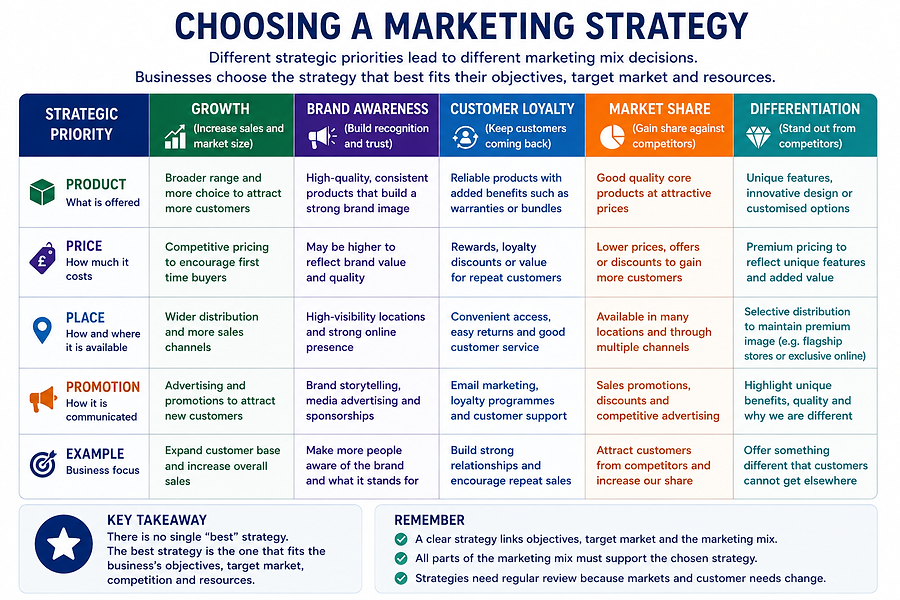
This chart compares different strategic priorities, such as growth, brand awareness, customer loyalty and market share, and shows how each priority may influence product, price, place and promotion decisions.
WORKED EXAMPLE
Worked Example: North Coast Coffee
How many coffees must be sold to break even?

Fixed Costs
£1,800
equity + long-term debt

Break-even output = Fixed costs ÷ Contribution per unit
Contribution per unit = Selling price − Variable cost
£3.50 − £1.10 = £2.40
1

Step 1: Calculate contribution
£3.50 − £1.10 = £2.40
Contribution per unit is the amount each coffee contributes towards fixed costs.

BREAK-EVEN OUTPUT:
750 coffees per month

EXAM TIP
Always explain what the number means for the business. Do not just calculate the break-even point.

Building a Marketing Strategy
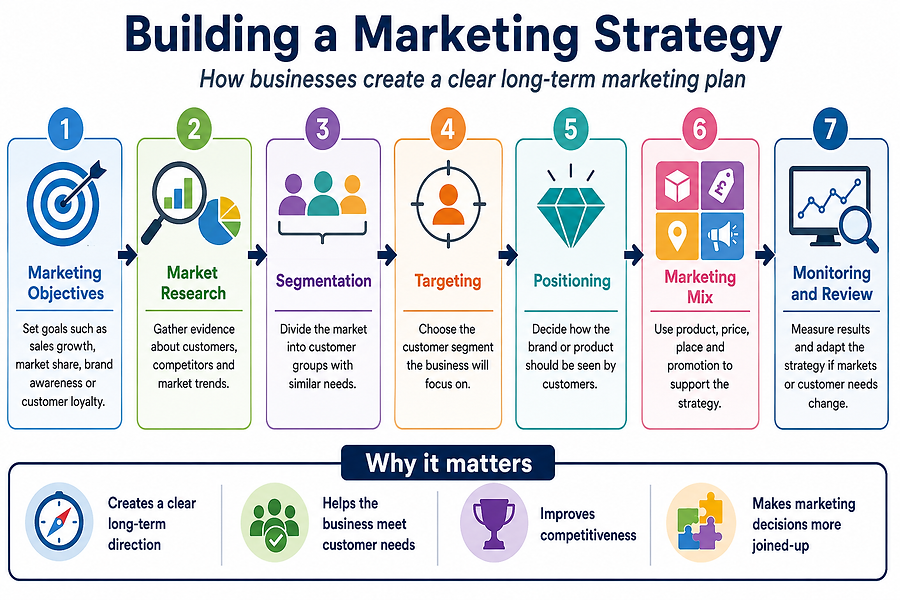
This diagram shows how marketing strategy is built from objectives, market research, segmentation, targeting, positioning and the marketing mix. It helps students see marketing strategy as a joined-up plan rather than a single promotional activity.
APPLICATION
IKEA
IKEA is a useful real-world example for understanding marketing strategy because its marketing decisions work together to support a clear position in the furniture and homeware market.
One part of IKEA’s strategy is to appeal to customers who want stylish and practical home products at prices that feel affordable. This means the product range, store layout, pricing and promotion all need to support the idea of good value and accessible design.
Product decisions are important because IKEA sells a wide range of furniture, storage, kitchenware and home accessories. This helps it appeal to customers furnishing different rooms, budgets and lifestyles. Its product range also supports repeat visits because customers may return for smaller homeware items as well as larger furniture purchases.
Place is also central to the strategy. Large stores allow customers to view room displays, test products and collect items, while online ordering and delivery help customers who prefer to browse and buy from home. This combination supports convenience and wider market reach.
Promotion helps IKEA communicate its positioning by focusing on home inspiration, practical solutions and value. This example shows how marketing strategy is not just one decision. It is the way product, price, place and promotion work together to create a clear and consistent offer for the target market.

This independent educational case study is not affiliated with, endorsed by or sponsored by Greggs plc. Any financial figures used alongside this example should be treated as simplified or hypothetical estimates created for teaching purposes.
_edited.png)
ANALYSIS
EXAM FOCUS
Analysis questions require you to examine a business concept or issue in detail, breaking it down into its component parts. You should explain how and why something happens and consider its impact on the business.

How to Approach Analysis Questions
1
Identify the key issue or concept
2
Break it down
3
Explain how and why
4
Reach a reasoned conclusion
Read the question carefully and highlight the focus of the analysis.
Consider the different factors, causes or impacts related to the issue.
Provide clear explanations using business terms and links points to context.
Evaluate the overall implications for the business.

Example Analysis Question
North Coast Coffee is considering using break-even analysis before opening a second café.
Advantages
• Sales forecasts may be inaccurate.
• Assumes costs and revenue remain constant.
• External factors may reduce reliability.
• Ignores qualitative business factors.
Disadvantages
• Sales forecasts may be inaccurate.
• Assumes costs and revenue remain constant.
• External factors may reduce reliability.
• Ignores qualitative business factors.
Key Exam Tip
If you find it difficult to expand your answer and show the type of depth that an examiner is looking for in a top response, consider using the 'so what' approach.
Tesco carry out market research - so what? - this allows them to better understand customer needs - so what? as a result Tesco can provide goods more likely to sell - so what? - this will increase Tesco profit and ensure higher levels of customer satisfaction - so what? this means that customers are likely to become more loyal to Tesco.

Avoid These Exam Traps
Students often lose marks on calculation and analysis questions by making these mistakes. Watch out for them in your exam!
1

Helvetica Light is an easy-to-read font, with tall and narrow letters, that works well on almost every site.
Helvetica Light is an easy-to-read font, with tall and narrow letters, that works well on almost every site.

Tip:
Helvetica Light is an easy-to-read font, with tall and narrow letters, that works well on almost every site.
2
Helvetica Light is an easy-to-read font, with tall and narrow letters, that works well on almost every site.
Helvetica Light is an easy-to-read font, with tall and narrow letters, that works well on almost every site.
Tip:
Helvetica Light is an easy-to-read font, with tall and narrow letters, that works well on almost every site.
3
Helvetica Light is an easy-to-read font, with tall and narrow letters, that works well on almost every site.
Helvetica Light is an easy-to-read font, with tall and narrow letters, that works well on almost every site.
Tip:
Helvetica Light is an easy-to-read font, with tall and narrow letters, that works well on almost every site.

Be precise. Read the question carefully. Show your working.
Small mistakes can cost big marks.
EXAM PRACTICE
Practice Question
Apply your knowledge of profit and profitability to answer this exam-style question.
1
MINI CASE STUDY
North Coast Coffee Ltd is a premium coffee business which sells freshly roasted coffee beans through its online store and a small chain of independent cafés. The business has experienced strong sales growth due to increasing demand for high-quality speciality coffee products.
The business generates annual revenue of £250,000. Its cost of sales, including coffee beans, packaging and direct production costs, totals £100,000. North Coast Coffee Ltd also faces operating expenses of £80,000, including marketing, employee wages, rent and administration costs. In addition, the business pays £20,000 in interest and taxation each year.
The owner, Mia Thompson, is reviewing the company’s profitability because rising wage costs and increased competition in the premium coffee market have started to place pressure on operating profit margins. She is considering increasing prices slightly in order to protect profitability while still maintaining customer demand.
.jpg)
2
EXAM QUESTION
Analyse the possible reasons for BrightBite’s falling profit margins and evaluate strategies it could use to improve profitability.
3
HOW TO ANSWER
P
Point
E
Explain
A
Apply
C
Consequence
H
However...
4
MODEL ANSWER
P
Point
Increasing prices could improve the profitability of North Coast Coffee Ltd because each sale would generate a larger amount of revenue and potentially increase profit margins.
5
EXAMINER TIP
For full marks, make sure you analyse causes rather than just listing them, and evaluate realistic strategies with clear judgement. THINK: Which strategy would have the biggest impact and why?

CALCULATOR
THIS TOPIC · POWERPOINT RESOURCE
Marketing Strategy
CHOOSE YOUR EXAM BOARD:
Product Title
Instant download — school site licence included
-
Fully editable PowerPoint lesson
-
Relevant activities and practice questions
-
School site licence — share with your department
Helvetica Light is an easy-to-read font, with tall and narrow letters, that works well on almost every site.

£3.00
RELATED TOPICS
Continue Learning
Build your understanding by exploring other topics that connect closely with this one.

Profit and Profitability
Learn how to calculate profit and analyse profitability to measure the financial performance of a business.