Strategy >
Political and Legal Environment
COVERS ALL MAJOR EXAM BOARDS
Teaching Business
Political Change
A clear guide to political change, covering government policy, trade agreements, protectionism, consumer protection, employee protection, competition policy, environmental regulation and business responses.
8

Created by an experienced Head of Business and examiner
_edited.png)
AQA | Edexcel | Cambridge | Eduqas | WJEC | OCR | GCSE
KEY POINTS
Political change refers to changes in government policy, law, regulation and political priorities that affect business decisions.
Political and legal changes can create opportunities and threats for businesses.
Trade agreements can make it easier or harder for firms to buy, sell and operate internationally.
Protectionism includes tariffs, quotas and trade regulations that restrict international trade.
Consumer protection laws affect product safety, advertising, refunds, quality standards and customer rights.
Employee protection laws affect pay, working conditions, equality, health and safety, contracts and dismissal.
Competition policy aims to prevent unfair market power, anti-competitive behaviour and consumer harm.
Environmental protection laws can increase costs but may also create opportunities for innovation and sustainable products.
Political change can affect marketing, operations, human resources, finance and long-term strategy.
Strong exam answers explain the specific political or legal change and judge how the business should respond.
KEY DEFINITION
Political change
Political change is a change in government policy, law, regulation, trade relationships or political priorities that affects how businesses operate and make decisions.
Main Explanation
Political change refers to changes in government policy, law, regulation, trade relationships and political priorities. These changes can affect business costs, demand, operations, employment, investment, competition and long-term strategy.
Political and legal change is an important part of the external environment. Businesses cannot usually control these changes, but they must monitor them and respond effectively. A change in law or government policy can create opportunities for some firms and threats for others.
Trade agreements are one important area of political change. A trade agreement may reduce tariffs, simplify customs procedures or make it easier for businesses to sell into overseas markets. This can create opportunities for exporters and firms with international supply chains.
However, changes to trade agreements can also create problems. If trade becomes more restricted, businesses may face higher costs, delays, extra paperwork or reduced access to important markets. This can affect pricing, delivery reliability and competitiveness.
Protectionism is another important political issue. Protectionism involves government policies that restrict international trade, such as tariffs, import quotas and trade regulations. These policies may protect domestic producers, but they can increase costs for businesses that import materials, components or finished goods.
Consumer protection laws can also affect business decisions. These laws may cover product safety, advertising, quality, refunds, customer rights and fair selling practices. Strong consumer protection can increase trust, but it may also increase compliance costs and require businesses to improve systems, staff training and product quality.
Employee protection is another key area. Employment laws may cover pay, working hours, contracts, dismissal, equality, health and safety and workplace conditions. These protections can improve fairness and motivation, but they may increase labour costs or reduce managerial flexibility.
Competition policy aims to prevent businesses from abusing market power or behaving unfairly. It can affect mergers, takeovers, pricing, collusion, market dominance and anti-competitive practices. For large firms, competition policy can limit strategic options. For smaller firms, it may create a fairer competitive environment.
Environmental protection laws are increasingly important. Governments may introduce regulations on emissions, packaging, waste, energy use, recycling, pollution or product standards. These laws can increase costs, but they may also create opportunities for businesses that innovate, reduce waste or develop greener products.
Political change can affect marketing decisions. For example, new consumer protection rules may require clearer advertising or product information. Environmental regulation may create demand for sustainable products and ethical promotion.
Political change can affect operations. A business may need to change suppliers, production methods, packaging, materials, quality systems or delivery processes to meet new rules. This may increase costs in the short term but improve efficiency or reputation in the long term.
Human resource decisions may also be affected. New employee protection laws may require changes to pay, contracts, training, equality policies, recruitment, working conditions or health and safety systems.
Finance can be affected because compliance often requires investment. Businesses may need to spend money on new equipment, legal advice, staff training, cleaner technology, product redesign or improved data systems. However, government grants or incentives may reduce the cost of adapting.
Political change can also influence strategy. A business may enter or leave markets, change production locations, adjust its product range or invest in new technology in response to regulation, trade policy or government priorities.
Overall, political change is not automatically positive or negative. Its impact depends on the type of business, the scale of the change, the cost of compliance, the response of competitors and whether the business can adapt quickly. Strong exam answers should identify the specific political or legal change, explain how it affects functional areas, and judge the most suitable business response.
✎ EXAMINER TIP
When analysing political change, be specific. Do not just say “the government affects business”. Name the change, explain the functional impact, then judge how the business should respond.
KEY FORMULAS(s)
Profit and Profitability Formulas
These key formulas help you calculate different profit measures and profitability ratios used in business.

Gross Profit
Gross profit = Revenue − Cost of sales
The profit made after deducting direct costs.
!
Remember: profit shows how much money has been made, while profitability shows how efficiently revenue is being turned into profit.
DATA TABLE
Income Statement for North Coast Coffee Ltd
This statement shows how revenue is converted into gross profit, operating profit and net profit.
Revenue
£250,000
Output
Fixed Costs
Variable Costs
Total Costs
Revenue
Profit / Loss
0 candles £1,200 £0 £1,200 £0 -£1,200
Net profit is the final profit remaining after all costs and expenses have been deducted from revenue.
Political Change: Opportunity, Threat and Response
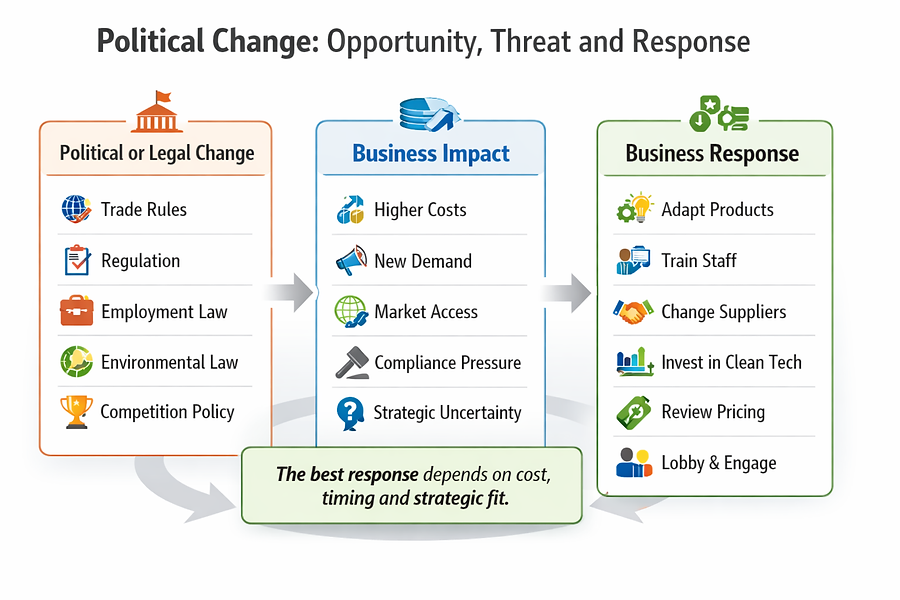
This chart shows how political change can create opportunities and threats, and how businesses may respond through marketing, operations, HR, finance and strategy.
WORKED EXAMPLE
Worked Example: North Coast Coffee
How many coffees must be sold to break even?

Fixed Costs
£1,800
equity + long-term debt

Break-even output = Fixed costs ÷ Contribution per unit
Contribution per unit = Selling price − Variable cost
£3.50 − £1.10 = £2.40
1

Step 1: Calculate contribution
£3.50 − £1.10 = £2.40
Contribution per unit is the amount each coffee contributes towards fixed costs.

BREAK-EVEN OUTPUT:
750 coffees per month

EXAM TIP
Always explain what the number means for the business. Do not just calculate the break-even point.

Types of Political and Legal Change Affecting Business

This diagram shows the main types of political and legal change that can affect businesses, including trade agreements, protectionism, consumer protection, employee protection, competition policy and environmental protection.
APPLICATION
Stellantis / Vauxhall Ellesmere Port
Stellantis and Vauxhall’s Ellesmere Port plant provide a useful real-world example of how political and legal change can influence business decisions. The UK’s move towards zero-emission vehicles, environmental regulation and government support for electric vehicle production have all affected automotive strategy.
Political change can create opportunities. Government policy encouraging electric vehicles can increase demand for electric vans and cars over time. For a manufacturer such as Stellantis, this creates a reason to invest in electric vehicle production, battery-related capability and new manufacturing processes.
The Ellesmere Port investment shows how government support can influence location and investment decisions. If financial support, infrastructure and policy certainty are available, a business may be more willing to commit capital to a major production site.
Environmental protection is also important. As governments place greater pressure on businesses to reduce emissions, car manufacturers need to adapt their product ranges. Producing electric vehicles can help the business respond to regulation and protect its long-term competitiveness.
However, political and legal change can also create threats. If regulations change quickly or if demand for electric vehicles grows more slowly than expected, manufacturers may face higher costs, unused capacity or pressure on profitability. Meeting new legal targets may require large investment before customer demand is fully established.
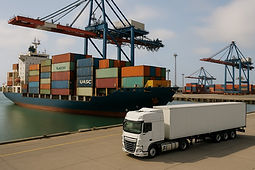
Trade policy can also matter. A car manufacturer may rely on imported components, export markets and international supply chains. Changes in trade agreements, tariffs or customs arrangements could affect costs, delivery times and competitiveness.
The Stellantis example shows that political change affects more than one functional area. Operations may change through new production methods, finance may be affected by investment costs, HR may need retraining and strategy may shift towards electric vehicles and sustainability.
The key judgement is that political change can create major opportunities when government policy supports a growing market, but it also increases risk if regulation, demand and investment costs do not align.
This independent educational case study is not affiliated with, endorsed by or sponsored by Greggs plc. Any financial figures used alongside this example should be treated as simplified or hypothetical estimates created for teaching purposes.
_edited.png)
ANALYSIS
EXAM FOCUS
Analysis questions require you to examine a business concept or issue in detail, breaking it down into its component parts. You should explain how and why something happens and consider its impact on the business.

How to Approach Analysis Questions
1
Identify the key issue or concept
2
Break it down
3
Explain how and why
4
Reach a reasoned conclusion
Read the question carefully and highlight the focus of the analysis.
Consider the different factors, causes or impacts related to the issue.
Provide clear explanations using business terms and links points to context.
Evaluate the overall implications for the business.

Example Analysis Question
North Coast Coffee is considering using break-even analysis before opening a second café.
Advantages
• Sales forecasts may be inaccurate.
• Assumes costs and revenue remain constant.
• External factors may reduce reliability.
• Ignores qualitative business factors.
Disadvantages
• Sales forecasts may be inaccurate.
• Assumes costs and revenue remain constant.
• External factors may reduce reliability.
• Ignores qualitative business factors.
Key Exam Tip
If you find it difficult to expand your answer and show the type of depth that an examiner is looking for in a top response, consider using the 'so what' approach.
Tesco carry out market research - so what? - this allows them to better understand customer needs - so what? as a result Tesco can provide goods more likely to sell - so what? - this will increase Tesco profit and ensure higher levels of customer satisfaction - so what? this means that customers are likely to become more loyal to Tesco.

Avoid These Exam Traps
Students often lose marks on calculation and analysis questions by making these mistakes. Watch out for them in your exam!
1

Helvetica Light is an easy-to-read font, with tall and narrow letters, that works well on almost every site.
Helvetica Light is an easy-to-read font, with tall and narrow letters, that works well on almost every site.

Tip:
Helvetica Light is an easy-to-read font, with tall and narrow letters, that works well on almost every site.
2
Helvetica Light is an easy-to-read font, with tall and narrow letters, that works well on almost every site.
Helvetica Light is an easy-to-read font, with tall and narrow letters, that works well on almost every site.
Tip:
Helvetica Light is an easy-to-read font, with tall and narrow letters, that works well on almost every site.
3
Helvetica Light is an easy-to-read font, with tall and narrow letters, that works well on almost every site.
Helvetica Light is an easy-to-read font, with tall and narrow letters, that works well on almost every site.
Tip:
Helvetica Light is an easy-to-read font, with tall and narrow letters, that works well on almost every site.

Be precise. Read the question carefully. Show your working.
Small mistakes can cost big marks.
EXAM PRACTICE
Practice Question
Apply your knowledge of profit and profitability to answer this exam-style question.
1
MINI CASE STUDY
North Coast Coffee Ltd is a premium coffee business which sells freshly roasted coffee beans through its online store and a small chain of independent cafés. The business has experienced strong sales growth due to increasing demand for high-quality speciality coffee products.
The business generates annual revenue of £250,000. Its cost of sales, including coffee beans, packaging and direct production costs, totals £100,000. North Coast Coffee Ltd also faces operating expenses of £80,000, including marketing, employee wages, rent and administration costs. In addition, the business pays £20,000 in interest and taxation each year.
The owner, Mia Thompson, is reviewing the company’s profitability because rising wage costs and increased competition in the premium coffee market have started to place pressure on operating profit margins. She is considering increasing prices slightly in order to protect profitability while still maintaining customer demand.
.jpg)
2
EXAM QUESTION
Analyse the possible reasons for BrightBite’s falling profit margins and evaluate strategies it could use to improve profitability.
3
HOW TO ANSWER
P
Point
E
Explain
A
Apply
C
Consequence
H
However...
4
MODEL ANSWER
P
Point
Increasing prices could improve the profitability of North Coast Coffee Ltd because each sale would generate a larger amount of revenue and potentially increase profit margins.
5
EXAMINER TIP
For full marks, make sure you analyse causes rather than just listing them, and evaluate realistic strategies with clear judgement. THINK: Which strategy would have the biggest impact and why?

CALCULATOR
THIS TOPIC · POWERPOINT RESOURCE
Political Change
CHOOSE YOUR EXAM BOARD:
Product Title
Instant download — school site licence included
-
Fully editable PowerPoint lesson
-
Relevant activities and practice questions
-
School site licence — share with your department
Helvetica Light is an easy-to-read font, with tall and narrow letters, that works well on almost every site.

£3.00
RELATED TOPICS
Continue Learning
Build your understanding by exploring other topics that connect closely with this one.

Profit and Profitability
Learn how to calculate profit and analyse profitability to measure the financial performance of a business.